August 12, 2018
June 18, 2018
Poor People’s Campaign

A crowd at the Midwest segment of the Poor People’s Campaign in Columbus, Ohio, on May 13, 1968. (AP Photo)
10 Reasons to Revive the 1968 Poor People’s Campaign
By Sarah Anderson
Inspired by an initiative cut short by the assassination of Dr. Martin Luther King Jr., moral leaders are planning a wave of civil disobedience.
When profit motives “are considered more important than people,” Dr. Martin Luther King Jr. once declared, it’s time for the nation to “undergo a radical revolution of values.”
To bring about that revolution, King and other leaders announced plans in December 1967 for a Poor People’s Campaign that would mobilize disadvantaged people across racial and geographic lines. Four months later, an assassin’s bullet prevented the campaign from reaching its full potential.
Today, 50 years later, we have a chance for a do-over. And do we ever need it.
At a press event today in Washington, DC, two prominent faith leaders—the Rev. Liz Theoharis and the Rev. Dr. William J. Barber II—announced plans for a new multi-issue, multiracial Poor People’s Campaign to recapture the revolutionary spirit of 1968. As the campaign’s co-chairs, they’ve been traveling the country for months, holding mass meetings and strategy sessions in 15 cities to lay the groundwork for mobilizations in the spring of 2018.
For those who may doubt the need for such a campaign, a new Institute for Policy Studies report provides more than ample evidence. By many measures, what King called the “evils of racism, economic exploitation, and militarism” are worse today than they were five decades ago. Toss in climate change and other environmental threats, and the picture is even more grim.
Here are just 10 of the numerical lowlights of the past 50 years:
1. Since 1968, the number of Americans below the official poverty line has increased by 60 percent to 40.6 million. While poverty rates are highest among African Americans and Latinos, white people make up the largest number of the country’s poor (17.3 million).
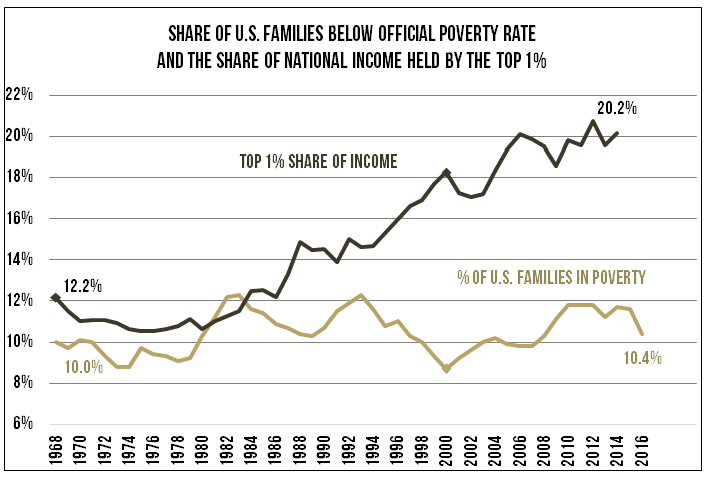
2. The top 1 percent’s share of national income has nearly doubled since 1968 while the official poverty rate for all US families has merely inched up and down. A key driver of this growing economic divide is the steep drop in unionization, from 24.9 percent of workers in 1968 to 10.7 percent in 2016. Income concentration at the top has siphoned resources from those at the bottom and distorted our democracy.
3. After some gains under President Johnson’s “War on Poverty,” the social safety net has taken a beating, with particularly devastating impacts on single mothers and children. In the richest country in the world, 30.6 million children (43 percent) live at or below 200 percent of the poverty line, considered the minimum for meeting basic family needs. Female-headed families are 5.4 times more likely to be living in poverty than families headed by married couples.
4. More than 50 years after the Voting Rights Act, people of color still face a broad range of barriers to democracy, including racist gerrymandering and redistricting, felony disenfranchisement, and laws designed to make it harder to vote. According to the Brennan Center for Justice, 23 states have adopted various forms of voter-suppression laws since 2010, with more restrictive voter-ID laws being the most common.
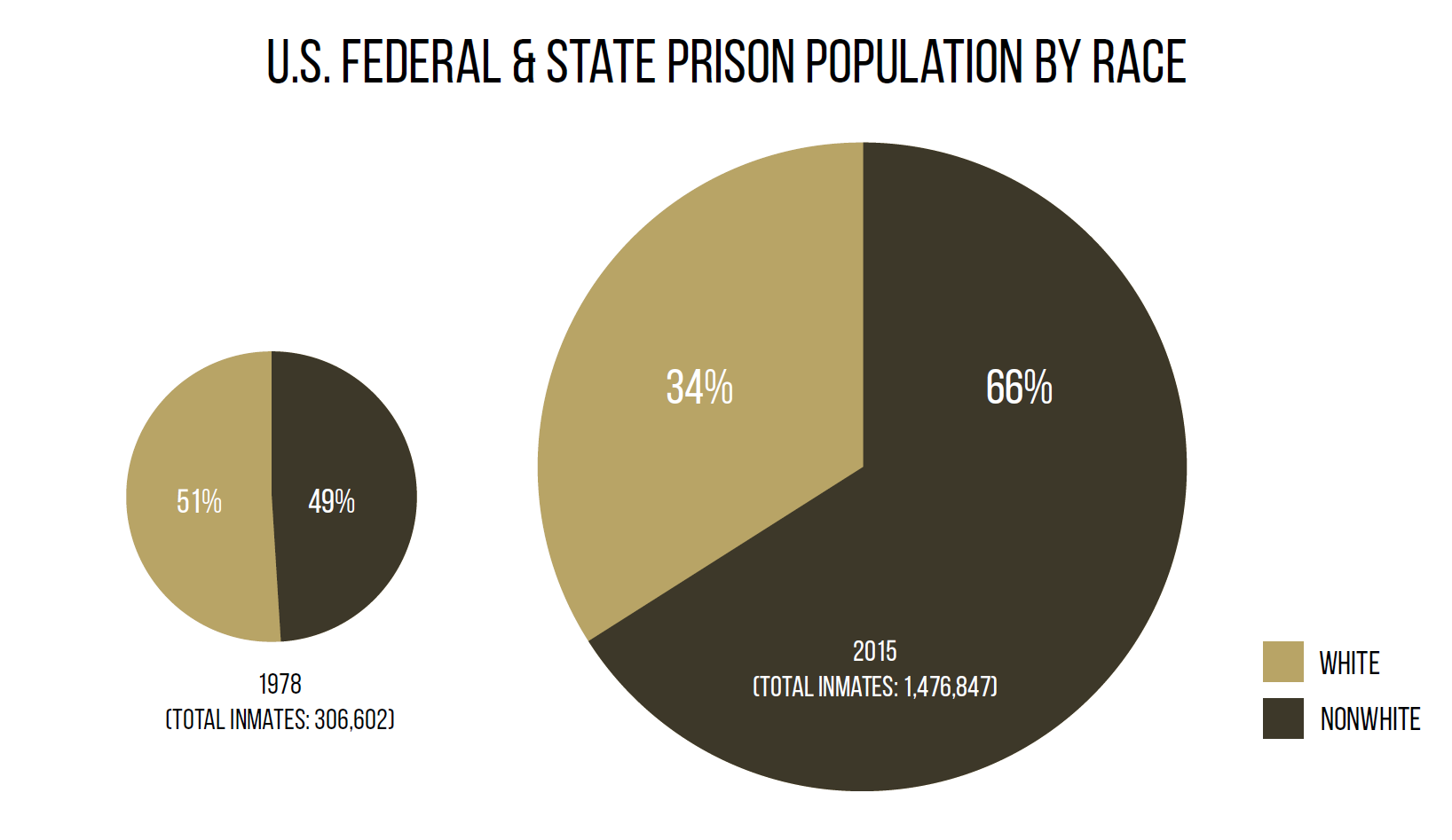
5. Since 1976, the criminalization of poverty has driven up federal spending on prisons tenfold to $7.5 billion this year. The number of state and federal prison inmates of all races grew from 188,000 in 1968 to 1.5 million in 2015. Racial profiling and biased sentencing and policing practices have expanded the share of inmates who are people of color from less than half in 1978 (the first year for which race data are available) to 66 percent in 2015.
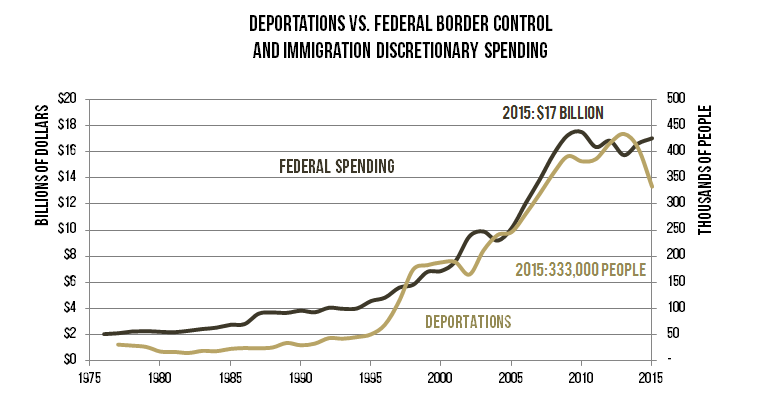
6. Increased scapegoating of immigrants is also reflected in government spending trends. Between 1976 and 2015, federal expenditures on border control and immigration enforcement rose eightfold while the number of deportees grew tenfold to 333,000.
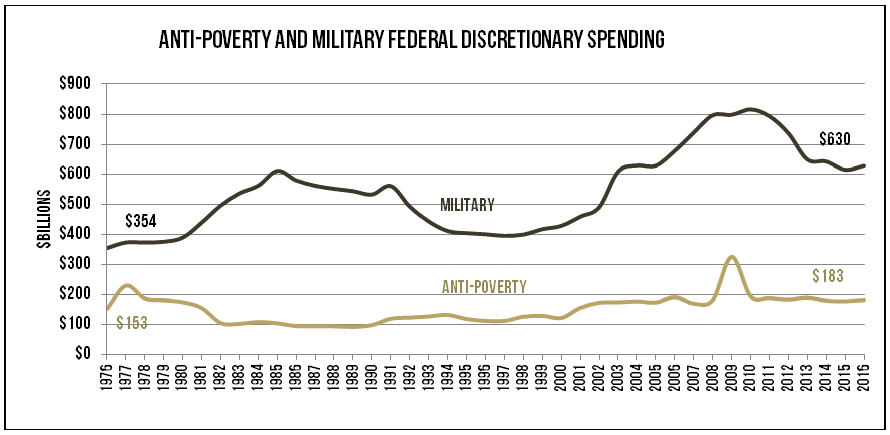
7. Since the height of the Vietnam War, the gap between Uncle Sam’s military and anti-poverty spending has gone even more out of whack. Back then, federal spending on the military amounted to twice the level of discretionary spending to fight poverty. Today this spending gap is nearly four-to-one. In the meantime, millions of lives have been lost in wars that have made us no safer, while “real security” in the form of good jobs, health care, and quality education remains beyond the reach of millions of Americans.
8. Disadvantaged communities here and abroad continue to pay the highest price for American militarism. The poorest 30 percent of US communities suffered 36 percent of the casualties in the Vietnam War and 38 percent in the Iraq War. And while the legal draft of the Vietnam era is no more, it has been replaced with an economic draft. Pentagon data on US casualties from Iraq and Afghanistan reveal that 23 percent came from job-scarce small towns and rural areas that represent only 17 percent of the US population.
9. Since 1968, the environment has become less polluted, but race and income disparities persist in access to clean air and water and exposure to environmental hazards. According to the Centers for Disease Control, at least 4 million families with children are being exposed to high levels of lead from drinking water and other sources. The risks fall heaviest on low-income, African-American, and Latino children, in part because they’re more likely to live in aging, poorly maintained housing.
10. Those who’ve contributed the least to climate change are suffering the most from the related severe weather effects. Low-income families and people of color tend to be more likely to have living conditions and jobs that increase the health risks of extreme heat. They also get hit hardest by natural disasters because of barriers to obtaining property insurance.
The point here, as campaign co-chair Theoharis puts it, is that “even before the election of Donald Trump, the evils of poverty, racism, militarism, and environmental destruction were tearing apart the social fabric in America.” (Theoharis is also co-director of the New York–based Kairos Center.)
And yet with Trump’s racist immigrant bashing and Republican tax and budget plans that would do more to accelerate inequality than any legislation in decades, the need for a modern-day Poor People’s Campaign is even more urgent.
In fact, the GOP tax plan is such a moral abomination that, if adopted, it will likely boost support for the 40 days of coordinated civil disobedience the campaign is planning to kick off on Mother’s Day 2018. Organizers are already expecting tens of thousands of poor and disenfranchised people, clergy, and other leaders to risk arrest in local actions that will feed into a major demonstration at the US Capitol on June 23.
These 50th-anniversary events will not be a commemoration, says Barber, who rose to national prominence as a driving force behind the Moral Mondays Movement. Rather, Barber says, the goal of the new Poor People’s Campaign is to “consecrate a new movement to transform the political, economic, and moral structures of society.”
https://www.thenation.com/article/10-reasons-to-revive-the-1968-poor-peoples-campaign/
May 13, 2018
"How He Loves" Anthony Evans (How God Loves Us, Powerful Song)
How He Loves Anthony Evans (How God Loves Us, Powerful Song)
April 1, 2018
Lord God, my creator

Lord God, my creator
You loved the peoples of this world so much that you gave your one and
only son that we might be called your children too and be saved. Lord,
help us to live and understand that it is done. In the gladness and grace of Easter Sunday, we praise you today and every day. You are so powerful that an act over 2000 years ago still works today.
Help us Let us have hearts of thankfulness for your
sacrifice. Let us have eyes that look upon your grace and
rejoice in our salvation. Help us to walk in that mighty grace
and tell your good news to the world.
All for your glory do we pray, Lord,
Amen, Amen, Amen
January 28, 2018
Rev. Dr. Martin Luther King National Holiday Service of Worship

Rev. Dr. Martin Luther King National Holiday Service of Worship
January 14th, 2018 - Convened by the Drum Major Institute, Healing for the Nations Foundation and Repairers of the Breach, Rev. Dr. William J. Barber, II is the guest speaker at this event featuring special music, personal testimonies and readings of MLK, hosted by Fifth Avenue Presbyterian Church in New York City and ending with a Saints Prayer March to Trump Tower.

November 12, 2017
October 8, 2017
PRAY FOR ME

THANKS TO GOD
I pray that this will bless you as it blessed me.
Hello God,
I called tonight
To talk a little while
I need a friend who'll listen
To my anxiety and trial.
You see,
I can't quite make it
Through a day just on my own...
I need your love to guide me,
So I'll never feel alone.
I want to ask you please to keep
My family safe and sound.
Come and fill their lives with confidence
For whatever fate they're bound.
Give me faith, dear God, to face
Each hour throughout the day,
And not to worry over things
I can't change in any way.
I thank you God for being home
And listening to my call,
For giving me such good advice
When I stumble and fall.
Your number, God, is the only one
That answers every time.
I never get a busy signal,
Never had to pay a dime.
So thank you, God, for listening
To my troubles and my sorrow.
Good night, God, I love You too,
And I'll call again tomorrow!
PRAY FOR ME PLAYLIST
September 17, 2017
CHANGE

There seems to always be a guarantee in life that change will happen. Change is something we tend to fear and become anxious about because we do not feel in control of life. The good news is that God has a plan for your life to hope, future, and to prosper. If we trust in God and allow the change to grow us to become more like Jesus Christ in how we respond and act, then we are promised that all things will work together for good for those who love Him and keep His commandments! We hope this playlist and Bible verses of change will give you peace and encouragement as you face the ups and downs in life. The words of TD Jakes will bless you.
TD Jakes - NOTHING AS POWERFUL AS A CHANGED MIND
CHANGED Playlist
Deuteronomy 31:6
Be strong and courageous. Do not be afraid or terrified because of them, for the LORD your God goes with you; he will never leave you nor forsake you.
Joshua 1:9
Have I not commanded you? Be strong and courageous. Do not be afraid; do not be discouraged, for the LORD your God will be with you wherever you go.
Psalm 18:2
The LORD is my rock, my fortress and my deliverer; my God is my rock, in whom I take refuge, my shield and the horn of my salvation, my stronghold.
August 6, 2017
CHANGED

CHANGED
God has changed me
God has changed the direction of my life
God has changed my heart
God has changed my understanding of my life
CHANGED - Playlist
July 19, 2017
Luther Barnes -The Other Shore --- & more
"That Other Shore" by Deborah Barnes
If My People
What More Can I Do
Jesus And Me
I'm Going Away
Heaven On My Mind


April 15, 2017
Sweet Hour Of Prayer by Rev. H.R. Rancifer

Thank you God for your grace and mercies your Love is everlasting.
March 5, 2017
The AME Church’s long struggle to overcome

The AME Church’s long struggle to overcome
The black church has a complicated history in America. It has been a central site for the organization of black movements for freedom and civil rights and has symbolized a growing black independence in America.
by Julius H. Bailey, Wikipedia added info
The African Methodist Episcopal Church was born, in fact, from a act of racist violence against peaceful black worshippers. In 1787 at Philadelphia’s St. George’s Methodist Episcopal Church, black members of the interracial congregation were inadvertently praying in the white section of the segregated church, which was under construction at the time. The black section of the church had been moved to another area, and the black members were unaware of the change. Instead of allowing the black members to finish praying and then moving to the black section, the white ushers forced them from their knees and physically began to move them to the black section.

Two of the members who experienced the assault, Absalom Jones and Richard Allen, went on to found the first AME Church in 1816 in Philadelphia.

Not accidentally, the AME Chuch’s assertion of black freedom of assembly and worship coincided with the origins of black freedom of the press. Even before the official founding of the church, as early as 1794, members of the nascent congregation, including Jones and Allen, worked to help Philadelphians during the yellow fever epidemic of 1793. However, the white press took the opportunity to disparage African-Americans and the AME Church. Matthew Carey, a well-known printer, claimed in a circulated pamphlet that African-Americans took advantage of the outbreak by burglarizing the homes of white people who had left the stricken city. In the absence of any countervoice by the American media, Jones and Allen published “A Narrative of the Proceedings of the Black People During the Late Awful Calamity in Philadelphia.” Setting the tone for subsequent African-American authors, Jones and Allen felt it was critical to correct the public record as quickly as possible to avert further fallout from the slanderous assertion. Not only did they challenge Carey’s characterization, but they also described the ways black people, at risk to their own health, helped a substantial number of white citizens during the crisis.
Emanuel African Methodist Episcopal (AME) Church

The AME Church in South Carolina shares this history of white violence and hostility toward black independence and religious life. In 1800, despite the First Amendment’s commitment to freedom of assembly and religion, the South Carolina legislature passed one of the many of the laws that made it illegal for African-Americans to gather for religious purposes before dawn or after sunset. Magistrates could break up these meetings at will. Many white people in early America worried that religion empowered African-Americans and could lead, without proper supervision, to disobedience or outright resistance and rebellion. In some areas of South Carolina, black Methodists outnumbered white Methodists 10 to 1. The growing independence of AME churches was often curtailed when concerns about their activities arose and white Methodists took back the privileges they had allowed, such as meeting in their own quarterly conferences, handling their own finances and exercising control of their memberships.
When a dispute over burial grounds in the cemetery arose, black members withdrew from those interracial churches to found their own communities and to worship in the manner that they thought best. In 1818 they founded an independent congregation called the African Church of Charleston.
This symbol of black independence was quickly followed by the harassment of black members, arrests and the closing of the church in 1821. Denmark Vesey, one of the members of the church, would not take the matter lying down. Along with several other carefully selected participants, he planned in 1822 to take the city of Charleston’s arsenal, kill the governor, set fire to the city and kill every white person that they encountered. However, this assault, planned for July 14 — Bastille Day, which was associated with the French Revolution’s abolishment of slavery in Haiti — was betrayed on June 14 by slaves who knew of the plot. Although they did not carry out a rebellion, even planning a slave revolt was punishable by death. Vesey and over 30 other followers were hanged, and the city demolished the church.
Given the tight restrictions on black movement and religious life in particular after the Vesey rebellion, the members of the church had to meet secretly and out of the sight of white people. They risked arrest and even their lives to worship in the way that they saw fit. It was not until the end of the Civil War in 1865 that the church was formally reorganized as Emanuel African Methodist Episcopal Church.
“Mother Emanuel” remained a symbol of black freedom and religious expression through the civil rights era. Martin Luther King Jr. and Roy Wilkins led rallies there in 1962, as did Coretta Scott King for striking hospital workers in 1969. Its pastor, the Rev. Clementa Pinckney, was a state senator and committed civil rights leader. One of the nine victims of the shooting, he embodied the spiritual and political significance of the church and its history.
AME put a high premium on education. In the 19th century, the AME Church of Ohio collaborated with the Methodist Episcopal Church, a predominantly white denomination, in sponsoring the second independent historically black college (HBCU), Wilberforce University in Ohio. By 1880, AME operated over 2,000 schools, chiefly in the South, with 155,000 students. For school houses they used church buildings; the ministers and their wives were the teachers; the congregations raised the money to keep schools operating at a time the segregated public schools were starved of funds.
The Mission of the African Methodist Episcopal Church is to minister to the social, spiritual, physical development of all people. At every level of the Connection and in every local church, the African Methodist Episcopal Church shall engage in carrying out the spirit of the original Free African Society, out of which the AME Church evolved: that is, to seek out and save the lost, and serve the needy. It is also the duty of the Church to continue to encourage all members to become involved in all aspects of church training. The ultimate purposes are: (1) make available God's biblical principles, (2) spread Christ's liberating gospel, and (3) provide continuing programs which will enhance the entire social development of all people. In order to meet the needs at every level of the Connection and in every local church, the AME Church shall implement strategies to train all members in: (1) Christian discipleship, (2)Christian leadership, (3) current teaching methods and materials, (4) the history and significance of the AME Church, (5) God's biblical principles, and (6) social development to which all should be applied to daily living.

President Barack Obama and First Lady Michelle Obama attend a church service at Metropolitan African Methodist Episcopal Church in Washington, D.C., on January 20, 2013

Subscribe to:
Posts (Atom)